Introduction
Before a chemical reagent or research sample is sent by courier / post, the items must be assessed against various “Dangerous Goods Regulations” to determine what actions must be taken to allow the material to be transported safely. Failure to comply with Dangerous Goods Regulations can result in prosecution by the transport authorities, but perhaps more importantly, following the regulations ensures that those involved in transporting Dangerous Goods are not exposed to unnecessary hazards and avoidable accidents are prevented.
For these reasons, packages containing research chemicals / samples must not be sent via courier / post without being assessed by an appropriately qualified person.
The process is summarised in the image below:

Assessment of Research Chemical / Samples
If you wish to send a package containing research samples, contact Kevin Jones (kj34) and provide the following details:
- Description of the sample(s) to be shipped (please include structures if appropriate)
- Total weight of the chemicals / materials
- Where the package is to be sent (i.e. what country is the package being sent to?)
- A safety data sheet (SDS) for the material(s) being sent (if available)
It is vital that an accurate description of the goods to be sent is provided, so please provide as much detail as possible.
At this stage, your local advisor will use a combination of safety data sheets and technical manuals to determine whether the materials are classed as dangerous goods.
- Non-Dangerous Goods: If the material is not listed as “not dangerous goods” or “not regulated for transport”, the material can be sent without any special restrictions or labelling, provided the goods are properly packaged (see section below).
- Dangerous Goods: If the chemicals / samples qualify as dangerous goods, shipping the material becomes more complex, often requiring detailed paperwork as well as specific packaging and signage.
Fortunately, staff typically only need to send small quantities of research chemicals / samples. As a result, packages containing dangerous goods often qualify for exemptions that make the process easier. These exemptions are discussed below.
Common Exemptions
“De Minimis” Quantities Exemptions: It is possible to send certain dangerous goods in “de minimis” quantities. In such cases, most of the Dangerous Goods Regulations no longer apply if certain stipulations are met. One requirement is that the amount per “inner container” does not exceed 1 g / 1 mL and the total amount does not exceed 100 g (i.e. it is possible to send up to 100 g of a dangerous good divided across 100 vials each containing 1 g). Another stipulation is that the inner containers must be suitably packaged to prevent breakage during transport (see section below).

Excepted Quantities Exemptions: If a research chemical / sample is classified as a dangerous good and cannot be sent in “de minimis” quantities (i.e. exceeds 100 g or cannot be easily divided into 1 g containers) it is often possible to send them as “excepted quantities”. This allows more material to be placed in each inner container and the total quantity that can be sent ranges from 300 – 1000 g / mL. Your local advisor will inform you of the total amount that can be shipped and how much can be placed in each inner container.
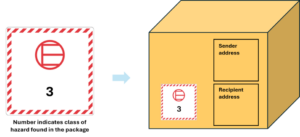
Packages containing dangerous goods in excepted quantities should be marked with an excepted quantities label. Your local advisor will inform you of a number that should be added to the label to indicate the type of hazard posed by the material within the package (e.g. the number 3 in the example below indicates the presence of a flammable liquid). The addresses of those sending and receiving the package should also be displayed on the outer container as shown in the picture below.
Packaging Requirements
If inner containers break during transit, there is a potential for those handling and receiving the package to be exposed to hazardous material. Similarly, if a flammable liquid leaks from the package this may result in a potential fire hazard.
Accordingly, samples should be securely packed with sufficient cushioning material such that, under normal conditions of transport, the sample containers cannot break. In the case of liquid samples, you are asked to use sufficient absorbent packaging material such that the entirety of the samples could be absorbed in the event all samples leak during transport.
It is also worth noting that, if you a reusing a cardboard box to send your chemicals / samples, this should have any labels removed as this is a common reason for materials to be returned by couriers.
Arranging Collection by Courier
Once your package has been reviewed, you will receive an e-mail confirming whether the package can be sent and any additional labels that need to be applied. This e-mail will be copied to our “Chem-Packages Team” who will help arrange collection by a courier.
The e-mail you receive will include an “information for packages” document. This contains all the information the Chem-Packages Team require to arrange a collection. You are asked to provide the requested information and send to [email protected]. The Chem-Packages Team will register the shipment with our courier and produce a label (waybill) that can be attached to the parcel using an adhesive plastic wallet (plastic wallets and jiffy bags are available from the general office – room 211).
The labelled package can then be taken to Purdie Stores for collection. Please do not bring chemical samples to the admin office
Copies of the “information for packages” documents can be found below
- Information Required by Courier & Instructions for Posting Packages (word version)
**Some browsers prevent word documents from being opened – please contact [email protected] if you run into any problems - Information Required by Courier & Instructions for Posting Packages (pdf version)
Determining if your material is a Dangerous Good
Often, the material being sent is novel and has no associated safety data sheet. In such instances, the flow chart below allows you to determine the likely requirements for your package and this is often useful to pass on to the Dangerous Goods Advisor. If you are unsure, please contact Kevin Jones in the first instance.
Radioactive Samples
Radioactive materials need a special assessment only available through EHSS. Please contact Kevin Jones (kj34) for further assistance.